Benelux, Durability
Benelux calls for global upgrade of fuel standards at COP31
10 Nov. 2026
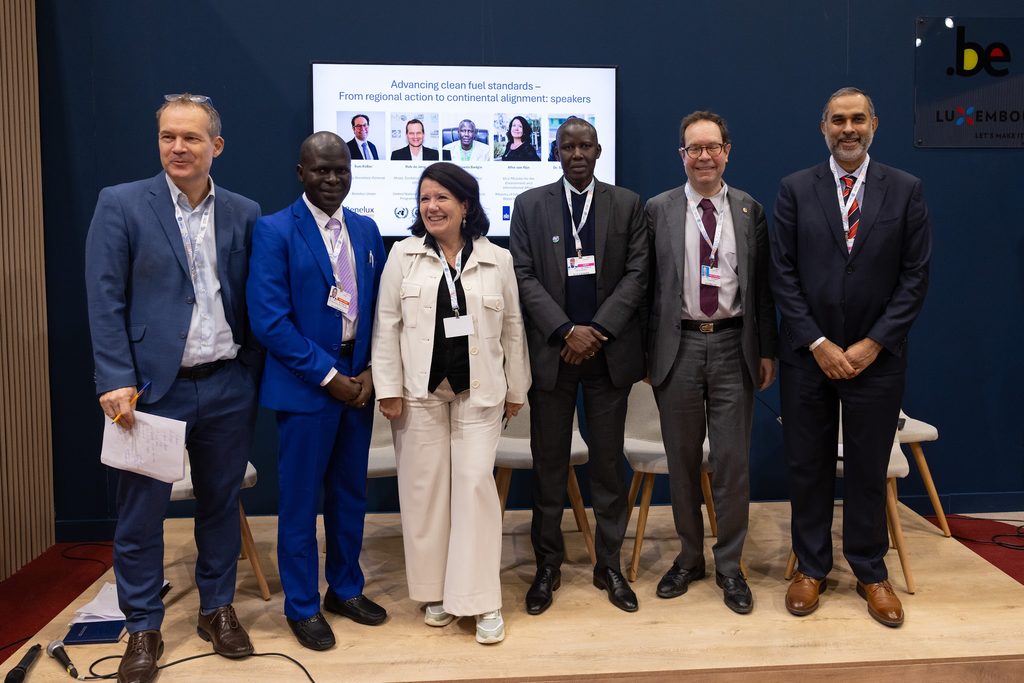
At COP31 in Antalya, the Benelux countries and the United Nations Environment Programme (UNEP) hosted a panel discussion at the Benelux-EIB Pavilion on cleaner transport fuels and the need for stronger fuel standards worldwide. Through the side event, “Advancing Clean Fuel Standards: From Regional Action to Continental Alignment,” speakers from The Gambia, the Netherlands and the oil industry highlighted how stronger fuel quality standards can improve air quality, protect public health and contribute to a fair and effective energy transition.
This is especially important for West-African countries, who import large quantities of automotive fuels from European countries. West-African countries and UNEP work together to introduce legal fuel standards. But that is not done in a flash, and in the meantime, low quality automotive fuels (which would never be allowed on the European market) are allowed to be imported and to cause harm.
To help to close the health gap now by limiting the supply of these low quality fuels, important exporters Belgium and the Netherlands have answered the call already and introduced quality norms for exports of automotive fuels to all third countries.
From regional cooperation to global impact
In 2024, the three Benelux countries adopted a joint recommendation aimed at better aligning their policies on the export of fuels and vehicles to countries outside the European Union. The recommendation promotes closer cooperation between inspection authorities, greater harmonisation of quality standards and intensified dialogue with destination countries and international partners.
By bringing this discussion to COP31, the Benelux elevated the issue to the global stage.
“The transition to zero emission mobility is key, but will still take some time.In the meantime, millions of vehicles around the world continue to run on petrol and diesel. Improving the quality of these fuels therefore remains a powerful tool for reducing air pollution, protecting public health andlow lowering emissions,” said Tom Köller, Deputy Secretary-General of the Benelux Union. “The Benelux seeks to bring countries together around a simple message: what benefits the health of our citizens and the environment should not stop at national borders.”
“For the Netherlands, cleaner fuels are a matter of public health and shared responsibility. Since 2022, we have applied requirements to road fuels exported outside the EU to ensure they meet the same quality standards as fuels permitted on our own market. An evaluation of these rules shows improvements in fuel quality, demonstrating that policy can make a real difference. I encourage other fuel-exporting and trading countries to explore how they, too, can contribute to this progress. Ultimately, cleaner fuels should not depend on where they are produced or sold.”, said Afke van Rijn, Vice Minister for the Environment and International Affairs at the Dutch Ministry of Infrastructure and Water Management.
“Countries in the global south are asking for better quality fuels and vehicles and are developing standards for this. UNEP welcomes the response from the BENELUX countries that have now adopted fuel quality standards for export to the global south. We need to replicate this to the global level – to ensure global harmonized global fuel and vehicles quality standards.” said Ms Sheila Aggarwal-Khan, Director, Industry and Economy Division, United Nations Environment Programme (UNEP).
Cooperation between exporters and importers
The discussion brought together a wide range of perspectives. Fuel-exporting and fuel-importing countries shared their experiences in introducing and enforcing cleaner fuel standards. Representatives from UNEP and the energy sector also contributed to the debate.
At the heart of the discussion was the question of how countries can work together to ensure a level playing field, improve compliance with standards and further reduce the harmful impacts of fossil transport fuels for as long as they remain part of the global energy mix.
Benelux on the global stage
Through its participation at COP31, the Benelux reaffirmed its ambition to contribute practical cross-border solutions to global challenges. Alongside its role as a laboratory for European cooperation, the Benelux is increasingly positioning itself as a partner in international efforts related to sustainability, the circular economy, mobility and resilience.
The side event at the Benelux-EIB Pavilion illustrated this ambition and demonstrated how regional cooperation can contribute to broader international progress.